Religious liberty and equal justice in Rhode Island
Download the illustrated PDF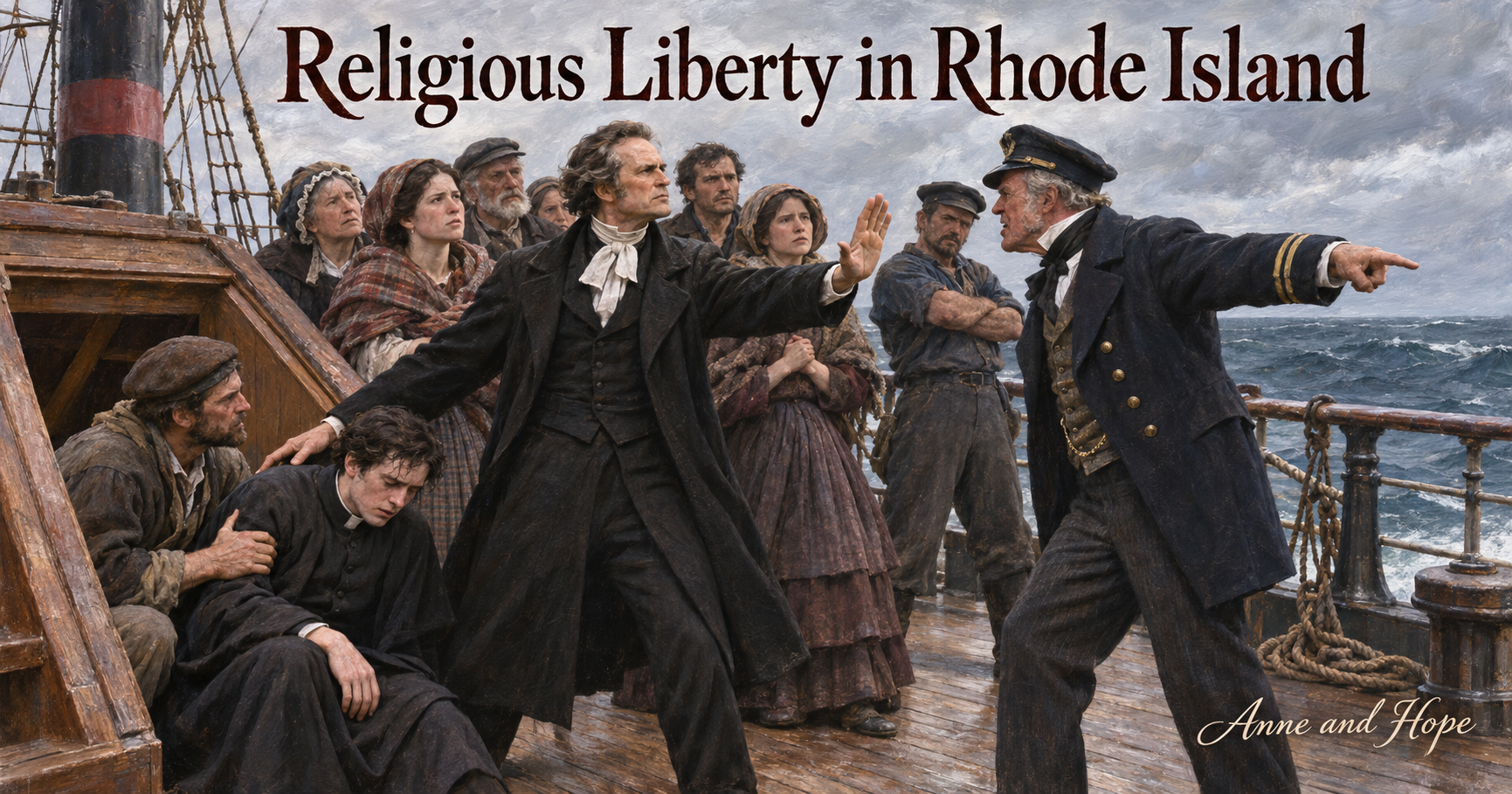
Religious liberty is easy to defend when the faith in question is your own. Its real test comes when your neighbor holds beliefs you find unfamiliar or even objectionable. Rhode Island was founded on the idea that people could disagree profoundly about God and still live together as equals. When the state makes it harder for one community to live by its faith, it weakens a protection every Rhode Islander may one day need.
When the Know-Nothings won Rhode Island
In the 1850s, the Know-Nothings turned anti-Catholic prejudice into a political program. The American Party asked its members to pledge that they would keep Roman Catholics out of public office, including Catholics born in the United States. A citizen could be fully qualified to serve and still be deemed unfit because of where they went to church.
Library of Congress, American Party pledge
That party won the governor’s office in Rhode Island. On April 4, 1855, Gov. William W. Hoppin won reelection with Whig and Know-Nothing backing. The Know-Nothings swept the statewide offices and won majorities in both chambers of the General Assembly. A year later, Hoppin won again on a joint Know-Nothing and Republican ticket. He stayed in office, and Rhode Island’s historic preservation commission identifies him as the state’s first Republican governor in 1856.
Rhode Island Historical Society Rhode Island statehouse history
Two years before that election, the priest who would become Providence’s first Catholic bishop nearly lost his life at sea. According to an account published by St. Bernard Church in North Kingstown, the newly ordained Father Thomas Francis Hendricken was sailing to America aboard the Columbia in 1853 when he went into steerage against the captain’s orders to give a dying woman last rites. The parish identifies the captain as president of a Know-Nothing lodge in Maine. It says he beat Hendricken unconscious and that a Protestant minister rallied fellow passengers to stop him from being thrown overboard. Hendricken went on to become the first bishop of Providence in 1872.
St. Bernard Church account Diocese of Providence
Rhode Island already had a constitutional guarantee against religious exclusion when Hoppin headed that ticket. Article I, Section 3 declares that no person shall be “disqualified from holding any office; nor otherwise suffer on account of such person’s religious belief.” It also protects the right to worship according to conscience and to defend one’s religious views openly. The Know-Nothings’ success here shows why Rhode Islanders have to defend that provision even in a state that prides itself on religious liberty.
Rhode Island Constitution, Article I, Section 3
1. The persecution that shaped Rhode Island’s founding
In Tudor England, being a Catholic could cost a person her home, her livelihood or her life. In 1534, Henry VIII’s government hanged Elizabeth Barton, the Nun of Kent, after she rebuked the king against setting aside Catherine of Aragon in defiance of the Pope to marry Anne Boleyn. Beginning in 1536, the Crown dissolved monasteries, convents and other religious houses and seized their property, including abbey churches and lands.
Elizabeth Barton UK National Archives, dissolution of the monasteries
Under Elizabeth I, Catholics could be fined for refusing to attend Church of England services. Authorities tortured some Catholic priests and executed about 100 during her reign. St. Edmund Campion was tortured in the Tower of London and executed in 1581. St. Margaret Clitherow was pressed to death in York in 1586 after refusing to plead to a charge of sheltering priests. St. Margaret Ward was hanged in 1588 for helping a priest escape, and St. Anne Line was hanged in 1601 after being convicted of sheltering one. The penalties reached into private homes, where giving a priest refuge could cost a person her life.
UK Parliament, persecution St. Edmund Campion St. Margaret Clitherow St. Margaret Ward St. Anne Line
Colonial New England had its own religious exclusions. Massachusetts Bay authorities banished Roger Williams and Anne Hutchinson over disputes involving religious belief and authority. They also banished Quakers and executed Mary Dyer after she returned in 1660. Rhode Island’s Royal Charter of 1663 protected people from punishment for differences in religion as long as they kept the civil peace. England took much longer to lift its barriers to public life. Even limited relief for Catholics provoked the anti-Catholic Gordon Riots in 1780. Parliament lifted major barriers to Catholics holding public office in 1829, and Jews gained admission to Parliament in 1858.
Library of Congress, religious dissent Royal Charter of 1663 Gordon Riots Catholic emancipation
2. The modern tests of religious liberty
Catholic Judge Luis Matos’ nomination to the Rhode Island Supreme Court became an occasion to question him about private pro-life views attributed to him from three decades earlier. The episode had the character of a political hit job. The message to pro-life Catholics was that the secret gatekeepers of public office would allow them to serve only if they first disavowed their religious convictions. A judicial nominee should be judged on his record and his ability to apply the law impartially.
Rhode Island Current, Matos hearing
During COVID, Catholic and Orthodox Jewish congregations had to go to court to defend their ability to worship together. In November 2020, the U.S. Supreme Court temporarily blocked New York from enforcing strict attendance limits against the Roman Catholic Diocese of Brooklyn and the Orthodox Jewish congregations that challenged them. The Court found that the limits likely violated the First Amendment because the state treated houses of worship more harshly than some secular establishments.
U.S. Supreme Court, Roman Catholic Diocese of Brooklyn v. Cuomo
The pandemic also tested protections for religious objections to vaccination. In 2021, Connecticut eliminated its religious exemption from school immunization requirements for new applicants, while preserving it for certain students who already had one. Rhode Island still recognizes religious objections to school immunization in state law. Yet its emergency COVID vaccination rule for health care workers allowed a medical exemption for on-site work and offered no religious exemption. A federal judge declined to block the rule in January 2022. Rhode Island was wrong to close the door on workers seeking an on-site exemption based on sincere religious convictions.
Connecticut school immunization requirements R.I. Gen. Laws § 16-38-2 Emergency rule Dr. T. v. McKee
In New York City, public school employees won a fresh review of their requests for religious accommodation. In November 2021, a federal appeals court found in Kane v. De Blasio that the employees were likely to succeed in challenging how the city had applied its exemption criteria to them. The court required a new review under standards that covered all sincerely held religious beliefs and left the vaccination mandate in place.
Second Circuit opinion, Kane v. De Blasio
3. The right to practice a faith
In 1883, the federal government’s Code of Indian Offenses prohibited Indigenous ceremonies, including the Sun Dance. Penalties could include withholding rations, hard labor or imprisonment. A century later, two members of the Native American Church lost their jobs after using peyote as a sacrament, and Oregon denied them unemployment benefits. In 1990, the U.S. Supreme Court inexplicably held that the First Amendment did not require Oregon to make a religious exception to its general peyote prohibition and so Congress expressly protected traditional Native American ceremonial use of peyote in 1994.
National Park Service history Employment Division v. Smith 42 U.S.C. § 1996a
That history has particular meaning for Alan Gordon and me. We experienced years of harassment tied to The Healing Church’s sacramental use of cannabis. We consider that religious persecution. We alleged violations of our religious freedom in a federal suit that named Peter Neronha among the defendants. The fight over peyote shows what can happen when officials mistakenly apply controlled substance laws to an entheogen a religious community uses as a sacrament.
Federal court record, Gordon et al. v. Neronha et al.
4. Equal accountability for child sexual abuse
At Attorney General Peter Neronha’s instigation, Rhode Island’s General Assembly reopened previously time-barred civil claims involving childhood sexual abuse from July 1, 2026, through June 30, 2028. Survivors can use that window to bring decades-old claims against people accused of abuse and institutions accused of enabling or concealing it. Neronha has moved to intervene in cases against the Diocese of Providence to defend the law’s constitutionality.
2026 Rhode Island Public Laws, chapter 81 Attorney General’s statement on intervention
The law draws a sharp distinction between public and private defendants. If a survivor proves that a state agency or other public entity covered by the statute enabled or concealed the abuse, the law limits damages to $100,000 and bars prejudgment interest. If a survivor proves the same kind of misconduct by a diocese or another private institution, the statute imposes no comparable dollar cap. It also adds 12% annual interest to qualifying damages awards in revived cases against private defendants.
2026 Rhode Island Public Laws, chapter 81
Why vigilance is necessary
In the 1850s, the Know-Nothings asked Rhode Islanders to keep Catholics out of public office. Today, the old prejudice can work through the people a candidate depends on. If a party chair can be threatened with removal for giving a Catholic nominee ordinary assistance, every party official who might help the next candidate gets the message.
Ashley Kalus first argued that Rhode Island Republican Party Chair Allyn Meyers should resign because he had done too little to help Republican candidates. When she learned that he had helped Alan Gordon, the party’s 2026 nominee for attorney general, she called the extent of that support “itself reason for him to resign.” She added, “I intend to discuss it with others.” Later in the exchange, she mocked the shofar and sacramental cannabis, both part of our Hebrew Catholic practice. I managed Gordon’s campaign and saw Meyers give the party’s nominee the ordinary assistance any Republican candidate should be able to expect.
X thread Seat of Wisdom article and screenshots
That is how the old Know-Nothing impulse can find its way back into Rhode Island Republican politics. A call to remove one chairman can warn everyone else that helping a candidate who practices a faith they disapprove of may cost them their own position. If Kalus believes Meyers did something improper, she should say publicly what he did.
Rhode Island Republican leaders should publicly repudiate Ashley Kalus and anyone else who would deny Catholics, Jews or members of any other faith the protections guaranteed by our Constitution. They should make clear that every duly nominated Republican candidate deserves the same ordinary support from the party, regardless of how that candidate worships.
Those who would deny constitutional protections to Catholics, Jews or people of any other faith are not Rhody Republicans.